Safety
Your tank and your bottles
Most of what keeps a propane system safe is simple: leave the valves and the fittings to us, keep the area around the tank clear, and keep an eye on the gauge. Here is the whole list.
Reading the gauge
Lift the lid on top of the tank. The dial reads in percent, not gallons — it shows how full the tank is. Check it when the weather turns, and check it before a cold week.
Call us while there is still gas in the tank. Waiting until the needle is on the bottom turns a routine delivery into a service call. Not sure what your gauge is telling you? Read it to us over the phone — (817) 444-4613.
Why running out is more than an inconvenience
When a tank runs dry, the gas stops, the pilots go out, and the system loses pressure.
Before anything gets lit again, the whole system has to be leak-tested. That is required by code any time service is interrupted — not a fee we invented. Then the pilots get relit and every appliance gets checked.
Do not relight anything yourself after a runout. Trying to relight before the leak test is one of the most common ways people get hurt.
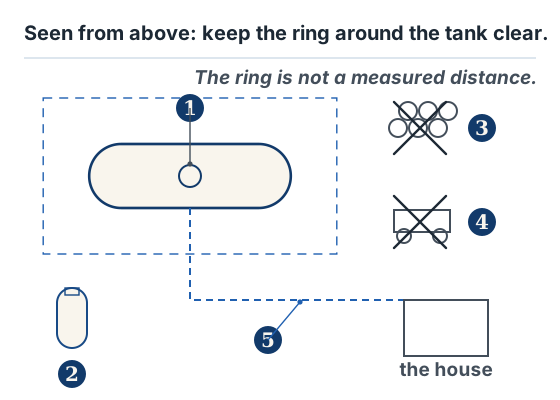
The list on this page, seen from above. The dashed ring is the clear ground the list asks for — it is not a measured distance.
- 1 The dome lid, on top. Lift it to read the gauge, and keep it free so the truck can fill.
- 2 A cylinder is portable — grill, RV, forklift. The ASME tank stays put.
- 3 Nothing stored against the tank or under it. Not firewood.
- 4 Not mowers, not trash, not tires. Keep the grass and brush cut back.
- 5 The gas line runs underground to the house. Call 811 before you dig, anywhere on the property.
Around the tank
- Keep it clear. Cut the grass and brush back, and keep the lid free so the gauge can be read and the truck can fill it.
- Do not store anything against the tank or under it. Not firewood, not mowers, not trash, not tires.
- Do not paint it a dark color, and do not let it rust. Rust inside an old steel tank can weaken the smell that warns you about a leak.
- Leave the valves, the regulator, and the fittings alone. Those are ours. If something hisses, drips frost, or does not look right, call — do not tighten it.
- Do not move or paint the tank or the regulator. Do not modify or tamper with any part of the system.
- Keep the tank and the gas lines protected from vehicles, livestock, equipment, and damage.
- Call 811 before you dig, anywhere on the property. Gas lines, water, and power all run underground, and a shovel finds them the hard way. It is a free call, and in Texas anybody you hire to dig has to make it.
The regulator
The regulator sits between the tank and the house. It steps high pressure down to what an appliance can use. Leave it to us. Do not paint it, do not move it, and do not cover the vent. Keep the vent clear of snow, ice, grass, and blowing dust. A blocked regulator vent is how a system starts to misbehave, and it is not something to fix with a screwdriver.
Know where the tank shutoff valve is and how to close it — turn the handwheel clockwise, to the right, until it stops. Use it only if you can reach it safely. If you smell gas, the valve is step three, not step one.
Grill bottles, RV bottles, forklift bottles
- They fill to 80%, on purpose. The rest is room for the liquid to expand when it gets hot. A 20-pound grill bottle holds a little under five gallons at that fill. A bottle filled to the top is a hazard, not a bargain, and the valve on it is built to stop that.
- Carry it upright and strapped down. Never on its side, never rolling loose in a trunk.
- Never leave one in a hot car, and never store one indoors — not the house, not the basement, not a closet, not a sealed shed. Outdoors, upright, out of the sun, away from anything hot.
Check the date on the collar
Every bottle is stamped with the month and year it was made, up on the ring around the valve. A bottle is good for twelve years from that date, and after that it has to be inspected and re-stamped before anyone can legally fill it again.
We look at that date on every bottle that comes across the counter, along with the valve, the foot ring, and any rust or dents. If it is out of date, we will tell you what your options are. We cannot fill it, and neither can anyone else.
What our driver checks on a delivery
The driver looks the tank over while it fills: the lid and the dome, the gauge, the regulator, the fittings, and the condition of the tank itself. If the driver sees something that needs attention, you will hear about it from us.
Bring it in, or call
Bring the bottle to the counter at 140 W Main St, or call (817) 444-4613 about the tank.
Tanks, refills and service · Duty to warn · Carbon monoxide · Storms and outages · Propane, plainly
Where this comes from
Tank, cylinder, and regulator guidance on this page follows the propane industry’s consumer safety information from the Propane Education & Research Council (PERC) and the National Propane Gas Association. Cylinders fill to a maximum of 80% to allow for expansion.
Emergency numbers
This page is general safety information, not a substitute for a technician. If you think you have a leak, get out and call 911 first.