The yearly notice
Duty to warn: what every propane customer should know
As your propane supplier, Rural Gas Supply Co. has a duty to tell you how propane behaves and how to stay safe. This page is that notice. It stays up all year, not just the week a letter lands in the mail.
Read it now, at our yard in Azle or from home. Share it with everyone who lives, works, or stays at the place we deliver to — a house, a farm, or a shop.
Emergency numbers
Why you get this notice
Propane is safe when it is handled right, and the handling is shared. We deliver the gas, fill the bottles, set the tank, and look the system over from our yard in Azle and on your place. What happens between our visits happens at your house, farm, or business, with nobody from Rural Gas standing in the kitchen. Once a year we put the important parts in writing, and we keep them here where you can find them at two in the morning.
What propane smells like
Propane is colorless and, in its natural state, odorless. For your safety, a strong odorant is added so that leaks can be detected. Most people describe the smell as rotten eggs, a skunk’s spray, or a dead animal. Make sure everyone in your home, farm, or business knows what propane smells like.
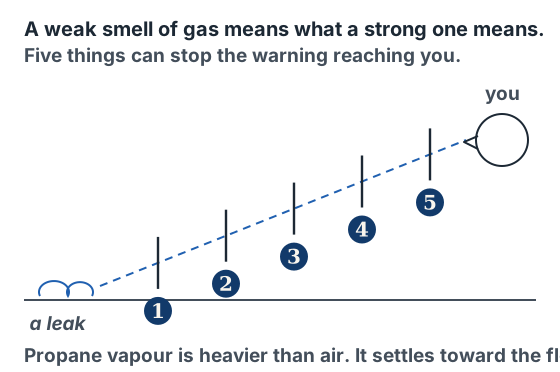
The warning has to travel from the leak to your nose. Five things can stop it.
- 1 The leak is underground — the odour can be filtered out as the gas passes through soil.
- 2 The odorant has faded, or stuck to the inside of pipes, to fabrics, or to other materials.
- 3 Smell fatigue — your nose gets used to an odour after a short time and stops noticing it.
- 4 Your sense of smell is reduced by age, a cold, allergies, sinus congestion, or tobacco.
- 5 You are asleep, and the smell does not wake you.
Important: you may not always smell a leak
On rare occasions, propane can lose its added odor. This is called odor fade, and it means you should not rely on your sense of smell alone. A leak may be hard or impossible to smell because:
- Your sense of smell is reduced by age, a cold, allergies, sinus congestion, or the use of tobacco or other substances.
- Smell fatigue sets in — your nose can become used to an odor after a short time and stop noticing it.
- The odorant has faded — air, water, or rust inside a tank, cylinder, or steel pipe can weaken the odorant, especially in a new container or one whose valve was left open after it ran empty. Cold or very dry air can also reduce the smell.
- The propane is leaking underground — the odor can be filtered out as the gas passes through soil.
- The odorant has stuck to surfaces — it can adhere to the inside of pipes, to fabrics, or to other materials between the leak and your nose.
- You are asleep — the smell may not wake you.
Because of odor fade, we strongly recommend installing propane gas detectors as an added layer of protection. A propane gas detector mounts low, because propane vapor is heavier than air and settles toward the floor. A carbon monoxide alarm is a different device for a different danger. A home with propane appliances wants both. Never assume that an absence of odor means an absence of gas. If you suspect a leak for any reason — a hissing sound, dead vegetation near the tank, an appliance that will not stay lit, or feeling sick indoors — treat it as a leak.
A weak smell of gas means exactly what a strong one means. Get out and call.
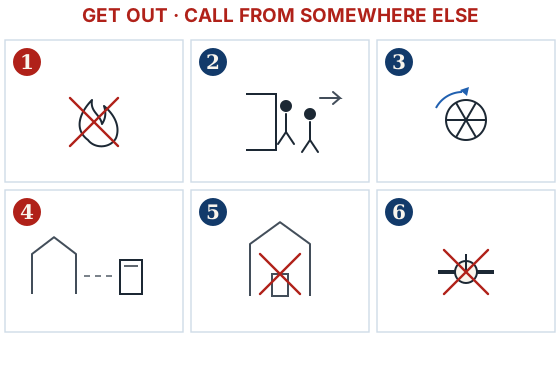
Get out, call 911, then call us. The order is the whole of it.
- 1 No flames, no sparks. Nothing electric — not a switch, not a phone.
- 2 Get everyone out of the building and away from the area.
- 3 Shut off the gas — clockwise — only if the valve is safe to reach.
- 4 Call from a safe distance. 911 first, then us.
- 5 Stay out until you are told it is safe.
- 6 Get the system checked before any appliance runs again.
If you smell gas — act immediately
If you smell propane or suspect a leak, treat it as an emergency. Follow these steps in order.
Do — in this order
- No flames or sparks. Put out all smoking materials and open flames at once.
- Leave immediately. Get everyone out of the building and away from the area. Do not stop to gather belongings.
- Shut off the gas if it is safe to reach — close the main supply valve on your tank by turning it to the right (clockwise). If you cannot safely reach it, skip this step.
- Call from a safe distance. From a neighbor’s home or well away from the building, call 911 first, then call us at (817) 444-4613.
- Stay out until your propane supplier or emergency responders tell you it is safe.
- Get the system checked. Before using any propane appliance again, have a qualified technician confirm the system is leak-free.
Do not
- Touch light switches, thermostats, or appliance controls — a switch can spark.
- Use any phone, including a cell phone, inside or near the building.
- Light matches or use a lighter.
- Try to find the leak yourself.
- Try to repair an appliance, relight a pilot light, or restart your system on your own.
Remember the order: get out, call 911, then call us. The six steps, in full →
Carbon monoxide — the invisible danger
Carbon monoxide (CO) is a toxic gas you cannot see or smell. It is produced when any fuel — propane, wood, oil, gasoline, or natural gas — does not burn completely. CO can build up when an appliance is faulty, poorly maintained, or improperly vented.
Symptoms of CO poisoning can feel like the flu without a fever: headache, dizziness, weakness, nausea, shortness of breath, sleepiness, confusion, or chest pain. Infants, older adults, and people with heart or breathing conditions are most at risk.
Warning signs of incomplete combustion include soot or black marks around appliances and vents, an unusual or burning smell, a yellow or wavering burner flame that should be blue, and excess moisture on the inside of windows.
- Install UL-listed carbon monoxide detectors on every level of your home and outside sleeping areas, and follow the manufacturer’s instructions.
- Have all propane appliances inspected by a qualified technician at least once a year.
- Never use a propane range, oven, or outdoor grill to heat your home.
- Keep vents, flues, and chimneys clear.
- If a CO alarm sounds, get everyone outside to fresh air immediately, then call 911.
Use qualified professionals — always
Propane appliances and equipment must be installed, serviced, and repaired only by qualified propane professionals. For your safety:
- Do not install, modify, adjust, or repair valves, regulators, connectors, controls, gas lines, or any other appliance or tank part yourself.
- Do not modify or tamper with your propane equipment, and do not move or paint your tank or regulator.
- Have appliances inspected regularly and serviced at the first sign of a problem.
- Keep your tank and gas lines protected from vehicles, livestock, equipment, and damage.
- Call us before you have any gas appliance connected or disconnected.
Portable cylinders (grills, RVs, and similar): use only DOT-approved cylinders and have them requalified on schedule; never overfill — cylinders are filled to a maximum of 80% to allow for expansion; always transport and store them upright and outdoors, never inside a home, garage, or closed vehicle.
Never let your tank run empty
Running out of propane is more than an inconvenience. If your tank runs out:
- When the tank empties, the system loses pressure and air can enter the lines. Pilot lights and open valves can also let air, moisture, and a loss of odorant into the system.
- A leak check and pressure test of the whole system is required before we can refill and restart it. That is required under the national fuel gas code any time service is interrupted — it is law, not our policy.
- Pilot lights must be safely relit by a qualified technician, never by you.
- Turn off the gas valve on your tank and call us at (817) 444-4613. Do not try to restart the system yourself.
Propane safety in storms and power outages
- Before a storm: know where your tank shutoff valve is and how to close it, and make sure your tank is secure. Fill before the weather, not during it.
- After flooding or high winds: do not turn on or use any propane appliance that has been underwater or exposed to flood water until a qualified technician has inspected it. Have your whole system checked for damage and leaks.
- Never use a propane generator, grill, or other outdoor propane appliance indoors or in a garage — carbon monoxide can be deadly.
- If a tank has shifted, floated, or its lines look damaged, stay away and call us and emergency responders.
- In winter: keep snow and ice cleared off your tank, regulator, vents, and chimney. A blocked vent can cause carbon monoxide to build up indoors. Mark your tank and the path to it so our truck can reach it.
- In dry, dusty wind: keep regulator vents clear of blowing sand and debris.
Who else in the house should read this
The person who smells gas first is not always the person who pays the bill. Whoever cooks, whoever does laundry, whoever is home in the daytime, the kids old enough to understand it, and anybody staying at the place while you are gone. If you rent the house out, the notice belongs in the tenant’s hands, not in a drawer. The same goes for a shop, a barn, or anyone who works the place.
Where this comes from
The consumer safety guidance behind this notice is published by the propane industry’s own council, the Propane Education & Research Council (PERC), and by the National Propane Gas Association. We link to both so you can read the original. We are a propane dealer in Azle, not a training body, and we do not claim to speak for either group.
- Propane safety overview (PERC / propane.com)
- PERC propane safety articles library
- National Propane Gas Association
- NFPA 58 Liquefied Petroleum Gas Code (reference)
NFPA 58 is adopted with state amendments by local authorities — always confirm specific requirements with your local Authority Having Jurisdiction.
Want a paper copy?
Ask for one at the counter at our yard in Azle, 140 W Main St, or ask when you call and we will get one to you. We deliver across our service area.
Summer hours (March 1 through September 30): Monday through Friday, 8 to 4. Closed Saturday.
Winter hours (October 1 through February 28): Monday through Friday, 8 to 5. Saturday, 8 to 1.
More propane safety
- Propane safety
The hub for every page on this list.
- If you smell gas
The six steps, in the order they matter.
- Carbon monoxide
What it is, what it feels like, and why a CO alarm is not a gas alarm.
- Your tank and your bottles
What to keep clear, what to leave to us, and the date on the collar.
- Storms, power outages, high water
Fill early. Keep the generator outside. Never relight it yourself.
- Propane, plainly
What propane is, and the words you will hear us use.
This page is general safety information, not a substitute for a technician. If you think you have a leak, get out and call 911 first.