Safety
Propane, plainly
If you are new to propane, or you grew up with it and never asked, here is the whole thing in plain words.
What propane is
Propane is a fuel that is kept as a liquid under pressure in a steel tank, and comes out as a gas when you open the valve. That is the whole trick: a lot of energy in a small space, sitting in your yard, ready whenever you need it. It does not need a pipeline from town, and it does not stop working when the power does.
Why it smells the way it does
Propane has no smell of its own. A strong-smelling chemical is added on purpose, so a leak announces itself long before the gas in the air could catch. The smell is the safety feature. It is supposed to be unpleasant, and it is supposed to make you get up and check.
Sometimes that smell is weaker than it should be. Rust inside an old steel tank, fresh concrete, a cold, or a nose that has gotten used to the smell can hide a leak. This is called odor fade. A weak smell of gas means the same thing a strong one does. Get out and call. If you smell gas, here are the six steps.
Where it shows up in a house
Heat. The water heater. The cooktop and oven. The clothes dryer. The fireplace. The grill on the patio. A standby generator. Out here it also runs shop heaters, stock tank heaters, and irrigation engines.
Who does what
- You watch the gauge, keep the area around the tank clear, and call when something smells or sounds wrong. You never have to diagnose it. That is not your job.
- We deliver the gas, fill your bottles, set and service the tank, and look the system over while we are there.
- A licensed technician does the work on the gas lines and the appliances inside the house — the leak test, the relights, the connections, the repairs. The code draws that line, based on training — not turf.
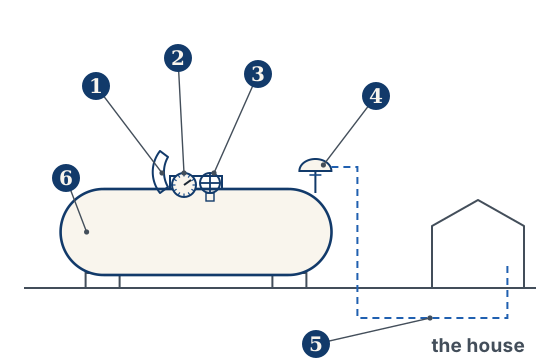
The parts, drawn. Six things, and only one of them is yours to touch.
- 1 The dome lid, on top of the tank. It lifts.
- 2 The gauge, under the lid. It reads percent full, not gallons.
- 3 The service valve. Leave it, the regulator and the fittings to us.
- 4 The regulator — it steps high pressure down to what an appliance can use.
- 5 The gas line, underground, to the house. Call 811 before you dig.
- 6 The ASME tank — the permanent tank in the yard, built to stay put.
Words you will hear us use
- Bobtail — the delivery truck with the tank on the back.
- Keep full — we watch the weather and your usage and come before you run low, without you calling.
- Will call — you watch the gauge and call us when you want a delivery.
- ASME tank — the permanent tank in the yard, built to stay put.
- Cylinder — a portable bottle. Grill, RV, forklift.
- Regulator — the part between the tank and the house that steps high pressure down to what an appliance can use.
- Gauge — the dial under the tank lid, reading percent full.
- Leak test — the pressure test a technician runs on the whole system before gas goes back on after any interruption.
- Requalification — the inspection and re-stamp a portable bottle needs when the date on its collar gets old enough.
Ask us how we handle deliveries for your place — call (817) 444-4613.
Still have a question?
That is what the phone is for. Call (817) 444-4613, or come by the counter at 140 W Main St, our yard in Azle. We deliver across our service area.
Duty to warn · If you smell gas · Carbon monoxide · Your tank and your bottles · Storms and outages
Where this comes from
The safety facts on this page follow the propane industry’s consumer safety information from the Propane Education & Research Council (PERC) and the National Propane Gas Association.
Emergency numbers
This page is general safety information, not a substitute for a technician. If you think you have a leak, get out and call 911 first.